
Your garage floor takes more abuse than almost any other surface in your house — hot tires, road salt, dropped tools, oil drips, and constant foot traffic. A Mint Concrete Coatings garage floor is built to shrug all of it off. We install a multi-layer epoxy and polyaspartic flake system that turns cracked, stained concrete into a seamless, easy-to-clean surface that looks as good in year ten as it does on day one.
Garage epoxy flooring is a multi-layer coating system applied directly over your existing concrete slab. At Mint, every garage floor is built in four layers:
That last layer is what separates a garage floor that lasts from one that doesn’t, which is why we want to slow down on it for a minute.
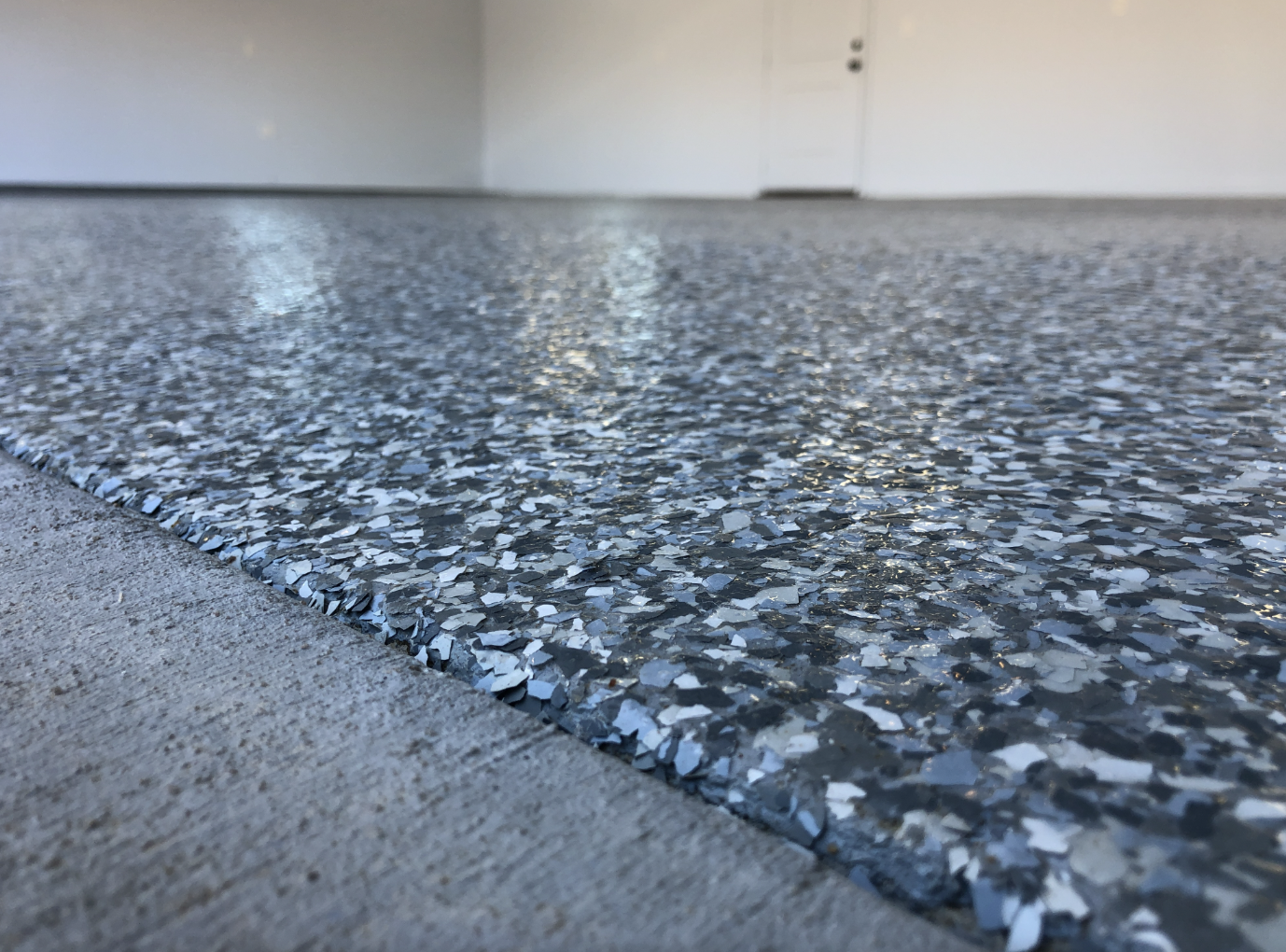
A lot of companies will coat your garage floor in epoxy and call it a day. We don’t, and here’s why.
Polyaspartic is dramatically more UV-stable than epoxy. Standard epoxy has a well-documented weakness: it ambers, yellows, and chalks when it’s exposed to UV light. If your garage has a window, gets afternoon sun through the open door, or just sees years of daylight every time you pull in and out, an all-epoxy system will visibly change color over time. Polyaspartic resin is chemically formulated to resist that UV breakdown, so the topcoat stays clear and the flake colors underneath stay true.
Polyaspartic cures fast and hard. Epoxy can take days to fully cure and remains relatively soft during that window. Polyaspartic cures in a fraction of the time and reaches a significantly harder final finish, which translates directly into better scratch and abrasion resistance — exactly what you need under a floor jack, a dropped socket set, or a dog’s nails.
Polyaspartic handles temperature swings better. Northeast Ohio garages deal with genuine seasonal extremes: sub-freezing winters, hot summer afternoons, and everything in between. Polyaspartic remains flexible and stable across that range far better than standard epoxy, which becomes brittle in the cold and can crack or delaminate as a result.
The bottom line: epoxy gives you strength, and polyaspartic gives you strength plus UV stability plus flexibility. Using both in one system, with polyaspartic as the protective topcoat, is how you get a floor that looks new for decades instead of a couple of winters.
We’re not a national franchise applying the same system in every climate. We coat garages that deal with:
Tracked in all winter long, which will eat through cheap sealers and unprotected concrete
From vehicles pulling in fresh off the highway in July, which can lift low-quality coatings right off the slab
That stress any coating system that isn’t properly adhered and flexible
Between seasons that can cause moisture vapor issues in improperly prepped concrete
Most residential garages are completed in one to two days, with the floor ready for foot traffic the next day and vehicle traffic shortly after — we’ll give you the exact timeline for your project during your quote.
We walk your garage, assess the concrete, and talk through flake colors and finish options.
We repair cracks and chips, then mechanically grind the slab to create the surface profile the coating needs to bond properly. This step is the single biggest factor in whether a floor lasts.
A high-build epoxy or polyaspartic base coat is rolled on for adhesion and strength.
Vinyl flakes are broadcast to full or partial coverage, depending on the look you want.
The UV-stable topcoat is applied, sealing everything in and giving you a durable, easy-to-clean finish.
If you’d rather not empty your own garage, our crew will move your belongings out before we start and put everything back once the floor is cured.
It’s worth being direct about this, because it’s the most common mistake we see homeowners make before they call us.
A box-store epoxy paint kit is a thin, single-coat product with no real surface prep behind it, often applied straight over unground concrete. It looks fine for a few months and then starts peeling in sheets, usually right where the tires sit. Our system is a professional, multi-layer buildup over properly ground concrete, finished with a UV-stable polyaspartic topcoat. It costs more upfront than a $150 kit from the hardware store — and it isn’t close in terms of how long it lasts or how it looks doing it.
Every metallic epoxy floor is backed by our 25-year warranty against peeling, delamination, and blistering from the concrete substrate under normal residential use, and it’s fully transferable if you sell your home.
This is an adhesion warranty, not a cosmetic warranty — it doesn’t cover fading, scratches, or chemical staining. That’s precisely why we insist on a UV-stable polyaspartic topcoat for every metallic floor: the goal is a finish that keeps its visual depth for decades, not one we simply promise to patch later.

Sweep or blow out grit and road debris regularly — fine particles are what cause the most visible surface wear over time
Hose down or mop with a mild, pH-neutral cleaner as needed
Wipe up oil, coolant, or de-icing salt residue when you notice it, even though the topcoat resists staining
Use furniture pads or a rubber mat under jack stands and heavy equipment to avoid concentrated point-loading
Avoid parking on the surface with bald, extremely hot tires within the first week of cure while the system fully hardens
Every garage is different — slab condition, square footage, and flake selection all affect the price. We give every customer a free, on-site, written quote before any work begins so there are no surprises.
A properly installed system with a polyaspartic topcoat typically lasts 15 to 25+ years in a residential garage. The two biggest factors are surface preparation (diamond grinding, crack repair) and topcoat quality — which is exactly why we don’t cut corners on either.
No, not with our system. The flake layer creates texture underneath the topcoat, which provides meaningfully better traction than a smooth, painted floor, even when wet from snow melt or a hose-down.
Yes, in most cases. We repair cracks and chips as part of our standard process before coating. Larger structural cracks may need additional repair work, which we’ll flag during your free quote.
Most homeowners can walk on the floor the next day and drive on it within a few days, depending on the specific system installed. We’ll give you exact timing for your project so you can plan around it.
Epoxy is a strong, thick base coating that bonds tightly to concrete. Polyaspartic is a faster-curing, more UV-stable, more flexible coating typically used as a topcoat. We use both together: epoxy for the base and polyaspartic for the topcoat, so you get the strengths of each.
No. We offer full-service item moving as an add-on — our crew will clear your garage before installation and put everything back once the floor is ready.
Call 440-732-3977 for your free quote.